October 23, 2025
Pacific Ridge School, Carlsbad, CA
https://www.pacificridge.org/community/north-county-mayors-forum

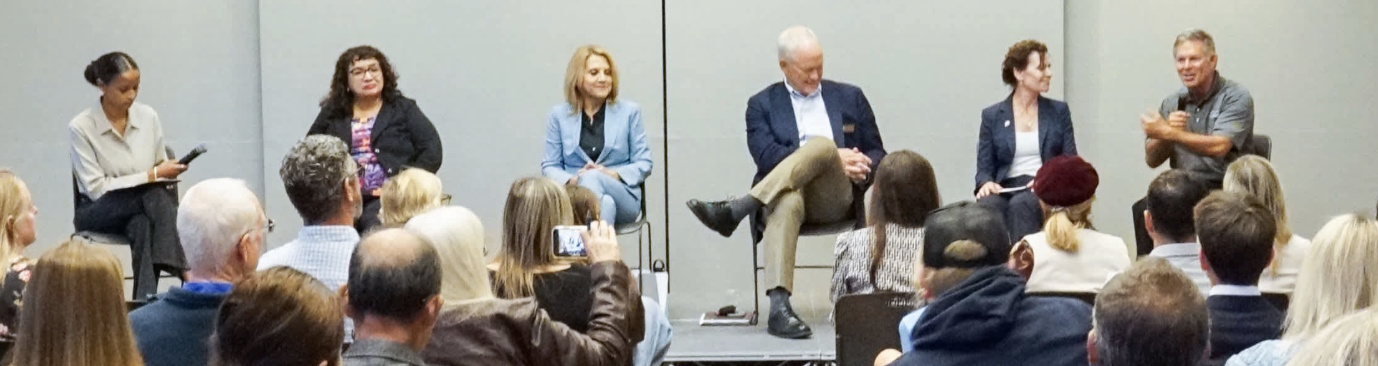
North County mayors discussed housing policy and homelessness at this community event. L to R: Bruce Ehlers (Encinitas), Rebecca Jones (San Marcos), Lisa Heebner (Solana Beach), Esther Sanchez (Oceanside), and Keith Blackburn (Carlsbad).
This forum was hosted by Pacific Ridge School and moderated by Voice of San Diego.
Here are the key takeaways from this event, organized by topic.
Housing Policy
Key Takeaway
California is not experiencing a housing shortage, but rather a housing affordability crisis. This crisis cannot be solved by blanket density mandates. Affordability requires funding, infrastructure capacity, and community trust—best achieved through locally driven planning and restored redevelopment resources.
1. State Housing Mandates vs. Local Control
Common Ground
All the mayors opposed the state’s increasing pre-emption of local land-use authority. They described Sacramento’s approach as “one-size-fits-all” and claimed it ignores infrastructure limits, community character, and local planning experience.
Key Quotes and Positions
- Blackburn (Carlsbad): State laws like SB 79 “violate” voter-approved growth limits; cities should build only as fast as infrastructure allows.
- Heebner (Solana Beach): Small cities with tiny infill parcels “cannot be treated like Los Angeles.”
- Ehlers (Encinitas): “Density is not a proxy for affordability.” He compared California’s mandates to density in New York or Hong Kong, which remain expensive.
- Sanchez (Oceanside): Over 70 housing bills since 2023 have “taken away local authority.”
- Jones (San Marcos): State “spot-zoning” and density-bonus rules erode community character and planning discipline.
2. Affordable Housing vs. Market-Rate Growth
Broad Consensus
The mayors agreed the real problem is affordability, not raw housing shortage. They distinguished between market-rate production and subsidized low-income housing, blaming state policy for stimulating luxury units rather than attainable ones.
Specific Points
- Heebner: The state counts luxury condos as “housing,” yet “no one complains there aren’t enough $2.5 million townhomes.”
- Ehlers: RHNA quotas (Regional Housing Needs Assessment) produce “single-digit” compliance rates for very-low-income units because “there’s no subsidy.”
- Jones: Redevelopment’s 2012 dissolution removed the main funding stream for affordable units.
- Sanchez: Oceanside meets market-rate targets but “low and very-low” categories lag; redevelopment loss means “zero gap funding.”
3. Redevelopment and Funding Shortfall
Historical Link
All five traced today’s affordability crisis to the 2011–12 elimination of redevelopment agencies, which once generated about $1 billion annually statewide for affordable-housing subsidies.
Key Points
- Heebner: Estimated $13 billion in lost funds since then and proposed allowing cities to retain more local property-tax increment (reviving the redevelopment concept).
- Ehlers: Noted that each low-income unit costs cities $500–700k in subsidy—money the state no longer provides.
- Jones: Explained how property-tax shares leave San Marcos with approximately 7 cents on the dollar, insufficient to cover services for tax-exempt affordable units.
4. Density-Bonus, ADUs, and “By-Right” Development
Critiques
- Unlimited waivers under California Density-Bonus Law let developers exceed local height, setback, and parking standards.
- SB 9 and ADU laws allow up to eight units on a single lot, often “four feet from the property line.”
- Projects qualifying as “by right” are CEQA-exempt and receive ministerial approval, eliminating public review.
- Result: loss of neighborhood character and over-stressed parking, utilities, and traffic networks.
Illustrations
- Jones: A six-story, 60-unit project on 1.3 acres with only 40 parking spaces in a single-family zone.
- Ehlers: Called density-bonus “double and triple dipping,” since developers count the same inclusionary units multiple times to gain height and density concessions.
- Sanchez: Warned density-bonus waivers undermine cities’ Climate-Action goals by dropping electrification and tree requirements.
5. Infrastructure and Fiscal Impacts
Theme
Cities bear long-term costs for state-mandated growth.
Key Points
- Blackburn: Developers once paid impact fees that ensured strong infrastructure; now “impact fees don’t come close.”
- Jones: “Affordable housing pays zero property tax,” shifting the cost of fire, police, and roads to the city.
- All mayors stressed that parking, traffic congestion, and utility systems can’t scale at the pace the state demands.
6. Community Character and Quality of Life
Key Perspectives
- Heebner: Defined community character as the intangible feeling of place; decried “soulless stucco boxes.”
- Sanchez: Said Oceanside has already allowed downtown height increases up to eight stories “by local choice,” proving cities can plan responsibly.
- Jones: Opposed “spot zoning” that injects six-story buildings into single-story neighborhoods.
- All mayors linked character preservation to residents’ trust in local democracy.
7. Regional Cooperation vs. Local Autonomy
Student Question
Should North County cities collaborate regionally?
Responses
- Blackburn: Opposed countywide allocation; wants each city to decide for itself.
- Heebner and Ehlers: Supported regional coordination so housing can locate where infrastructure and land make sense. Example: Build near job centers like Sorrento Valley rather than forcing density in small coastal towns.
8. Proposed Remedies and Political Advocacy
Recurring Solutions
- Restore redevelopment-style funding or new local-tax retention tools.
- Tie mandates to funding—no unfunded mandates.
- Back the “Our Neighborhood Voices” constitutional initiative (2028 ballot) to restore local land-use control.
- Public education and voting: Replace legislators “making these horrible bills.”
9. Broader Context and Rhetoric
Key Themes
- Several mayors accused state legislators of hypocrisy or cowardice for forcing cities to approve unwanted projects.
- Ehlers framed current developer influence as a modern version of the “robber barons,” justifying use of the initiative process.
- Sanchez urged young voters to mobilize for local control and warned of “horrible projects” coming soon.
- Blackburn cautioned residents not to blame local councils for “yes” votes forced by state law.
10. Overall Takeaway
Across partisan lines, North County mayors presented a unified front:
- The housing crisis is primarily an affordability and funding crisis, not a production or density crisis.
- Local control, infrastructure pacing, redevelopment funding, and inclusionary requirements are their preferred levers.
- They view state pre-emption and density bonuses as eroding community trust and environmental goals.
- Their collective message: “Let cities plan their own growth—with funding restored and accountability returned to local voters.”
Homelessness
Key Takeaway
Homelessness isn’t a single problem with a single solution. It requires locally driven, prevention-focused solutions that combine housing with mental-health and addiction support—backed by sustainable funding rather than unfunded state mandates—and must reflect each community’s diverse needs and accountability to its own residents.
1. Homelessness Is Not a Monolithic Issue
Key Insight
Mayors emphasized the diversity of homeless populations, noting that solutions must be tailored.
Key Quotes
- Mayor Bruce Ehlers (Encinitas):
“Not all homeless are equal… temporarily homeless, car homeless, mentally ill, drug addicted… you’re not going to have a single one-size-fits-all shelter.” - Mayor Keith Blackburn (Carlsbad):
“We have people who are mentally or physically unable to care for themselves… living in our bushes. Those people need more than just housing.”
Takeaway
Mayors reject “one-size-fits-all” homelessness policy and support a spectrum of interventions.
2. Prevention Over Reaction
Preventing homelessness is seen as more effective and humane than waiting until crisis.
Key Quote
- Mayor Blackburn (Carlsbad):
“If we could prevent homelessness, that would be so much cheaper and more effective than waiting until they’re living on the streets.”
3. Supportive Services Are Critical
Shelter alone is not considered a viable solution without services.
Key Quotes
- Mayor Rebecca Jones (San Marcos) referencing “shell game” policies:
“What happened to helping them before you house them? You’re just housing the problem.” - Mayor Ehlers (Encinitas):
“We need supportive services… hybrid solution… patchwork to meet the patchwork of people.”
4. Some Homeless Individuals Decline Services
Several mayors stated that a portion of the homeless population resists traditional housing and services.
Key Quotes
- Mayor Blackburn (Carlsbad):
Recounted a homeless resident telling him: “Why are you pushing your lifestyle on me?… I drink beer in the park with my friends.” - Blackburn continued: “People who choose meth over housing… that should be a police problem.”
5. Substance Use and Mental Health as Drivers
Key Quote
- Blackburn (Carlsbad):
“‘I’m a meth addict because I’m homeless… I had to get on meth to tolerate being homeless.’”
Key Insight
Addiction is often described as a consequence of unsheltered life, not only a cause.
6. Unfunded Mandates Criticized
The mayors opposed state requirements to provide housing without funding.
Key Quotes
- Mayor Ehlers (Encinitas):
“There’s no funding, unfunded mandate… there will be a lawsuit.” - Mayor Sanchez (Oceanside):
“We can do plans… but we cannot pay for it.”
7. Regional vs. Local Responsibility
Cities stressed prioritizing their own residents while selectively partnering regionally.
Key Quote
- Mayor Sanchez (Oceanside):
“We had people coming from other parts of the county… our homeless population is growing… priority has to be Oceanside residents.”
Key Insight
Cities report increased homelessness when shelters serve those from outside their jurisdiction.
8. Accountability to Residents
Mayors emphasized local accountability over state-level directives.
Key Quote
- Mayor Sanchez (Oceanside):
“We’re closer to the ground… you get stopped at the grocery store and get an earful.”